I have played guitar for thirty years. I still take lessons.
I have played guitar every day for thirty years. I still take lessons.
Not because I play badly. Because every time I understand one more piece of theory, I find three I do not. Why the same four chords sound melancholic in one order and triumphant in another. Why a chord borrowed from a parallel key sounds like longing. Why "aim for the third" is usable advice, once somebody tells you which third.
What I never had, sitting down to write, was a way in. I would arrive with a feeling, something sad, something britpop, something with a swagger, and no idea which chords produce it. The theory was in books. It was not in my hands.
So I spent this year putting what I keep learning into an app. It is called Some Might Play, it is on iPhone, and it shipped this month.
It starts from the feeling
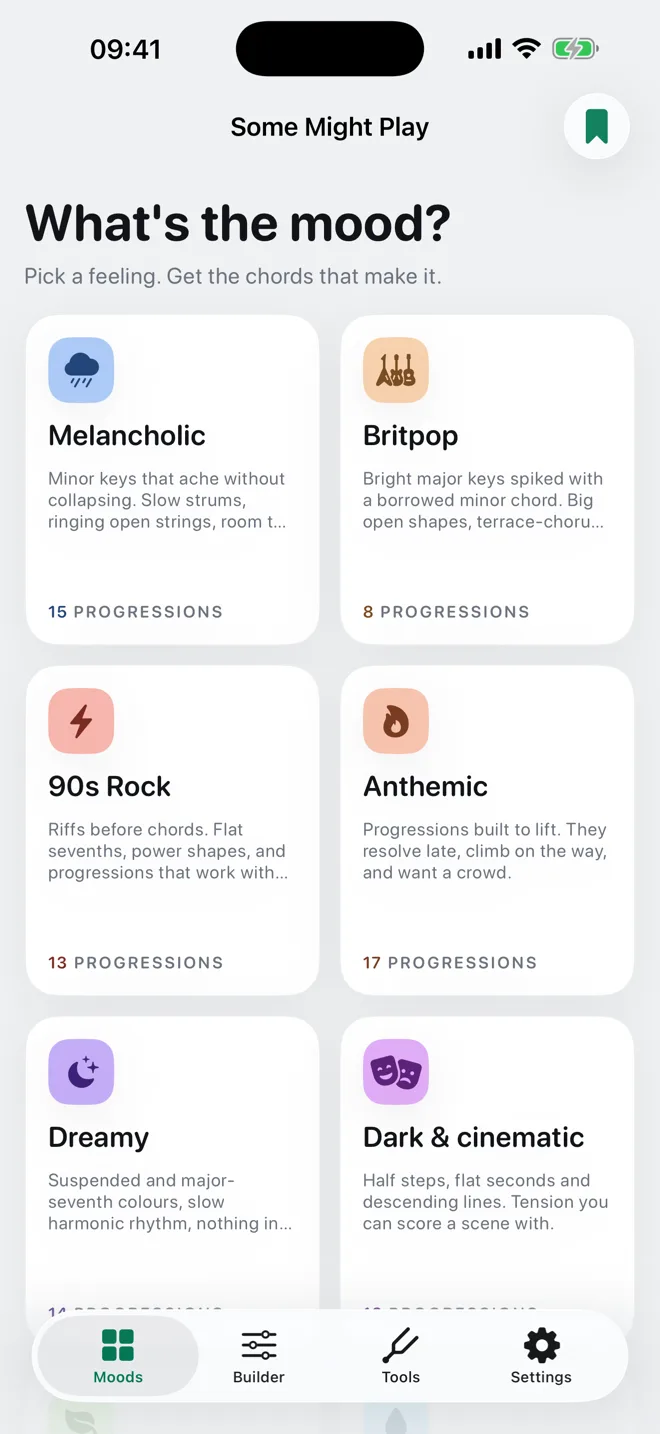
You pick a mood. Sixteen of them, melancholic, britpop, 90s rock, dreamy, defiant. You get progressions that sound like that, and each one says what it is doing in words a player would use rather than a theorist.
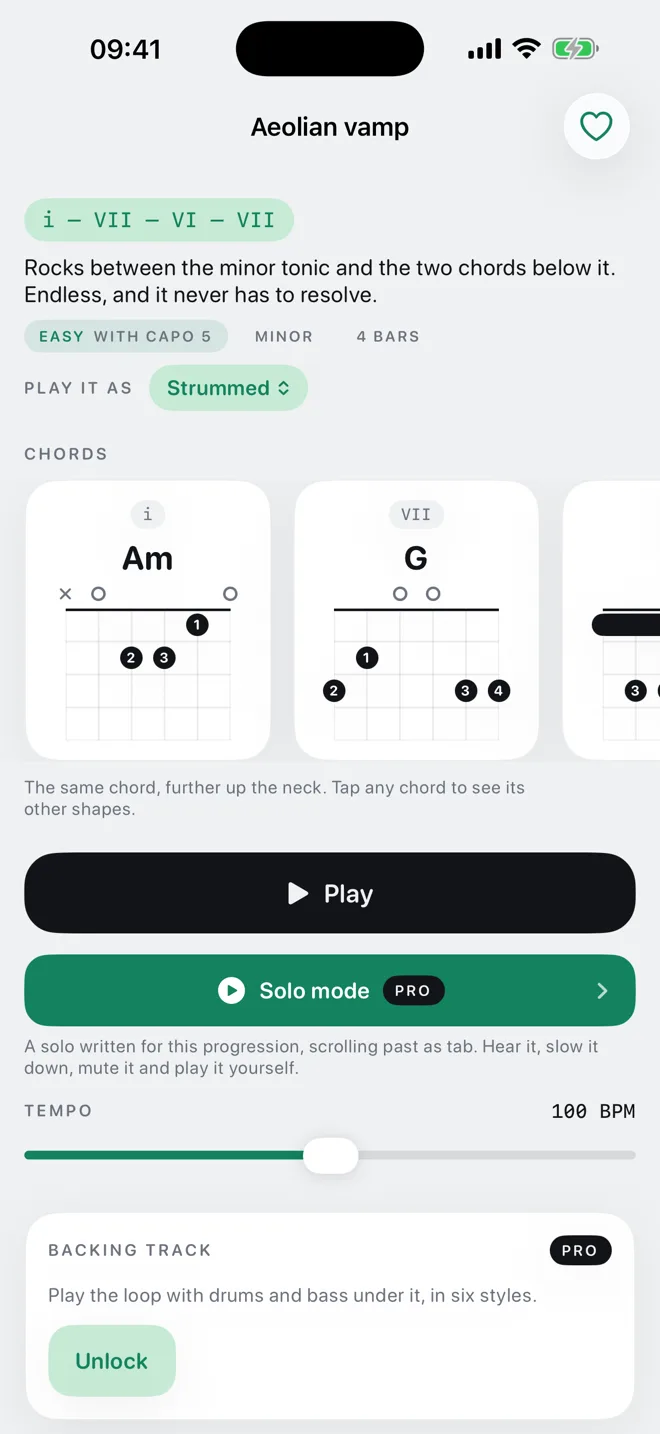
The one in that screenshot is stored as i - VII - VI - VII, described as rocking between the minor tonic and the two chords below it, and never resolving. That is the aeolian vamp, and once you can name it you start hearing it everywhere.
The decision the whole app rests on
No progression is ever stored as chord letters.
Every one of the fifty-seven is held as roman numerals and a mode. i - VII - VI - VII, not Am - G - F - G. The chords are worked out when you open it, in whatever key you asked for.
That sounds like a detail. It is the reason the app works.
Store Am - G - F - G and you have one progression, in one key, useful to whoever happens to want A minor that day. Store i - VII - VI - VII and you have the same progression in all twelve keys, because what makes it sound the way it does is the relationship between the chords, not the letters. Which matters the first time somebody tries to sing over it and finds that the key it was written in is not the key their voice wants. One tap, and it is in theirs.
It also means I can reason about the music. The app knows which degree each chord is, so it knows which scales fit and why, which note to aim for on each chord, and which notes you can hold through a change. None of that is possible if your data is a list of chord names.
Shapes a hand can hold
The chord diagrams are generated from fret positions, never shipped as pictures. Open shapes where they exist, movable shapes everywhere else, every position of every chord, and left-handed for free, which costs nothing to support and is infuriating to be charged for.
Because the app knows the fingering, it can also spot something a beginner cannot:
B♭ F Gm E♭ is four barre chords, and if you are six months in, that progression is closed to you. Put a capo on the third fret and the same progression becomes G D Em C, which is four open shapes and playable on your first evening. The app works that out and offers the swap in one tap.
That is the piece I am most pleased with, because it does not teach you anything or show you a diagram. It just removes the obstacle.
Soloing was the hard part
Playing over changes is the thing I have spent the most lessons on and understood the slowest. "Use the minor pentatonic" gets you notes that fit. It does not get you a phrase that lands.
What actually helps is knowing which note belongs to the chord playing right now, which one belongs to the chord arriving next, and that landing on one of those at the moment of the change is the difference between a line that resolves and a line that merely fits.
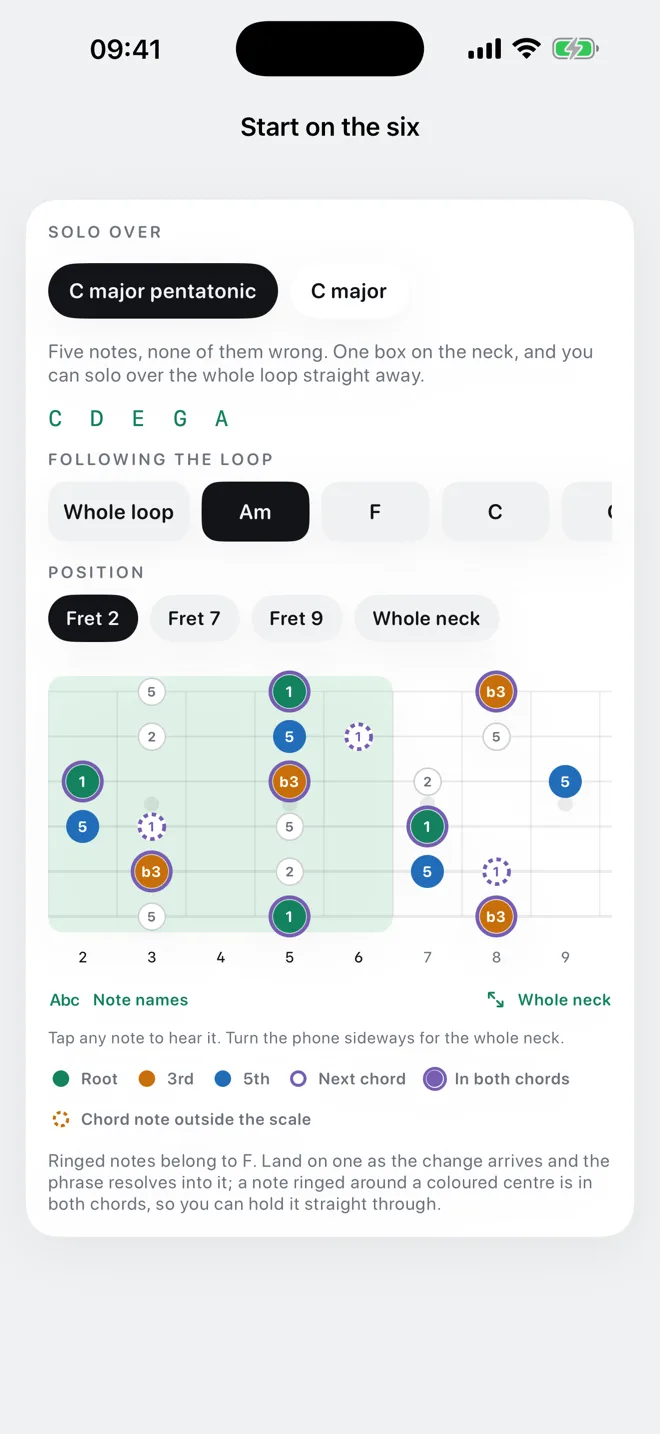
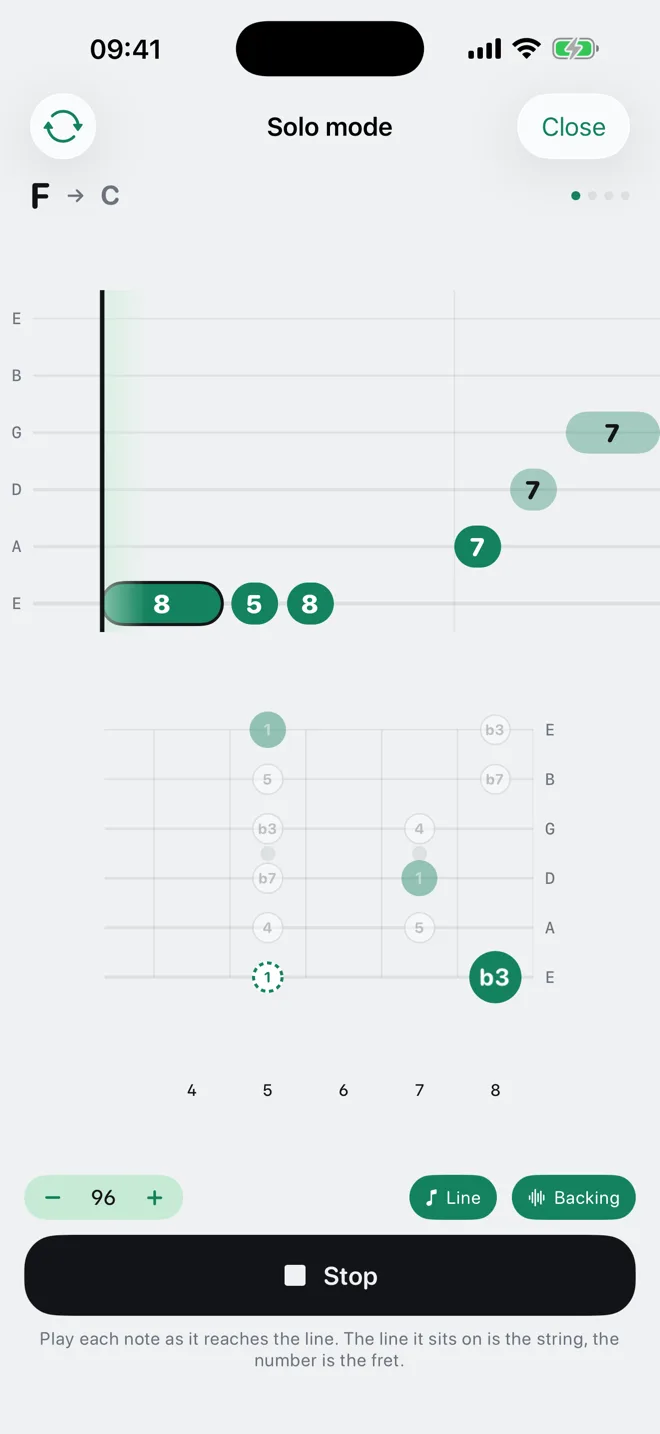
So the neck is drawn by scale degree rather than by note name, with the target note marked on each chord.
And when that is still too abstract, which it was for me for about twenty years, the app writes the solo for you and scrolls it past as tablature while the neck lights up underneath. You hear it, you slow it down, you mute it, you take it over.
Or write your own
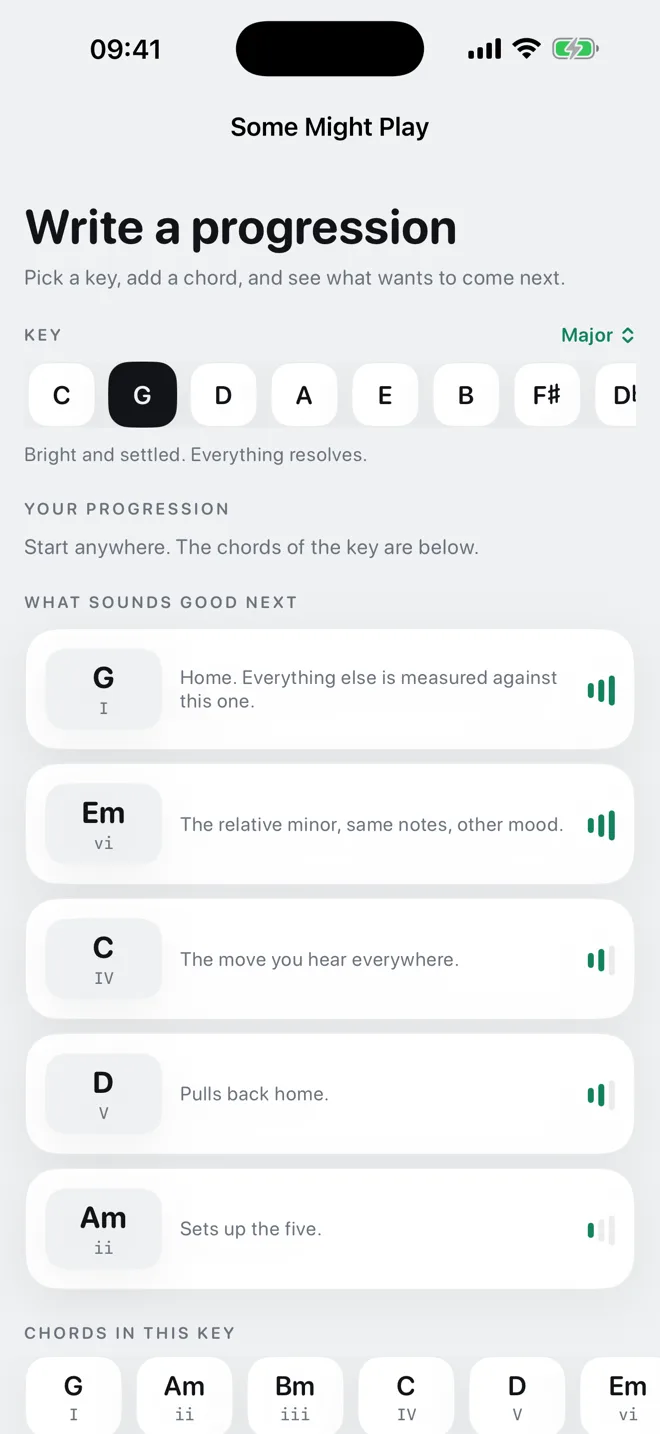
Pick a key, add a chord, and you get ranked continuations with the reason each one was offered. Not "here are the chords in this key", which is a table you can find anywhere, but why this one pulls harder than that one from where you are standing.
There is also a chromatic tuner that works in a noisy room, a metronome, and a small game for learning the neck. Those stay free, because charging for a tuner is beneath everyone.
No networking code. None.
The app makes no network requests, because there is no code in it that could. No analytics, no crash reporting, no advertising SDK, no third party anything, no AI service. The chord shapes are computed from music theory, and every sound you hear, including the drums, the bass and the written solo, is synthesised on your phone at the moment it plays. There are no audio files in the bundle.
The only thing that ever talks to a server is StoreKit, when you buy the paid half.
I have spent the last two months writing about an industry that reads everything and gives nothing back, and about a coal basin being reopened to power data centres. It would have been strange to then ship something that phones home about what you play at two in the morning.
It also makes the privacy answer short. Nothing is collected because nothing leaves.
What it costs
Free to download, and a good deal of it stays free: all sixteen moods, the progressions, the chord diagrams in every key, the capo advice, the soloing guidance, the tuner, the metronome, the game.
One payment of 7.99 euros unlocks the rest: drums and bass in six styles, solo mode, every position on the neck with triads and CAGED shapes, saving your own progressions and arranging them into songs, and a printable one-page chart made to sit on a music stand.
No subscription, no account, no advertising. English and French throughout, including every mood name and every description.
What I want to know
The part I cannot work out on my own is what is missing.
I built this for the way I write, which is one guitarist's way, and thirty years of habit is not the same thing as being right. If you play, try it and tell me what you reached for and did not find. That is the version 1.1 I actually want to build.